
The Goldilocks Solution to Your Workforce Needs that Feels Juuuuust Right
Lately, I have been writing more and more about workforce shortages, and to date, we have been thinking about this from a programmatic perspective. But this is also impacting your back-office staff including finance, revenue development, operations and marketing..
According to a recent report by Work Institute, the global turnover rate has increased to 20% in 2024. This coupled with a report from the International Labour Organization, which suggests that the average employee tenure has decreased from 4.5 years to 4.2 years in the last two years calls out to us all to respond to a need to determine just how we are going to get our work done!
We recognize that as demographics are shifting, meeting our staff where they are at is vital to beating the retention odds. Whether you are hiring older adults or Gen Z, millennials or those in the sandwich generation, there is a need to offer flexible hours, varied work schedules and alternative solutions to commuting.
But no matter how much you invest in meeting your staff where they are, organizations are being forced to reconcile their staffing challenges and budgets with the very real and pertinent needs to get the work done and to employ people with experience and expertise.
Recently, we were talking to a prospective client, who explained that he didn’t want to hire a consultant because he needed someone who would wake up dreaming about his organization. He wanted someone as invested as his staff was, and he didn’t feel like he would receive that level of commitment from a consultant.
This was eye opening to me, as our team is the type of people who call clients with ideas we came up with while walking our dogs, in our dreams, and while driving. But to be honest there is a difference between a consultant, a contractor and this lesser known term…fractional staff. And those differences matter when you hire us or any agency.
Knowing which you need and which will truly answer your needs is vital, as you are in your budgeting process and looking at your staffing plans. Here is a simple, easy to understand breakdown.
Consulting implies that you want someone who can be strategic and thoughtful. A consultant is going to look under the hood, ask questions, really understand the challenges and opportunities, and then develop and sometimes implement plans and outline the resources required to make it happen.
A contractor is someone who fills in your blanks. They tend to be short-term in nature and fill in the holes that you have in your staffing structure. Need a communications plan or a new sales kit, a program designed or an event planned? You’ll probably hire a contractor for this work. You’ll sometimes see this type of hire listed as an interim solution.
But what is a fractional staff person?
In a perfect, resource-unlimited world, it would be ideal to hire seasoned experts with decades of experience to fully join your team and dedicate their professional life to your mission. But unfortunately, there are limits to consider. If you are able to find the perfect candidate with deep industry knowledge, a strong network, and the ability to both lead and execute… they are going to require a salary that matches the value they bring. Either you’re going to be stretched and stressed financially, or you’re going to low ball them and risk resentment and a blow to your company culture long term. If you find someone a bit more green, you can offer them a fair wage at a lower price point, but you sacrifice the depth of experience that they bring - as well as the time you’ll need to dedicate to reviewing their work, overseeing and mentoring them.
In this case, fractional services are the goldilocks solution..they really are juuuuust right.
But how are fractional services different from consulting or contracting? Fractional staff tend to be 1099 employees who work with you for a limited amount of time each week or month. They tend to consider themselves a part of your team and a good fractional staff member will focus on goals and outcomes more than billable hours. You get the ethos of a dedicated employee, without the cost of a full salary and benefits.
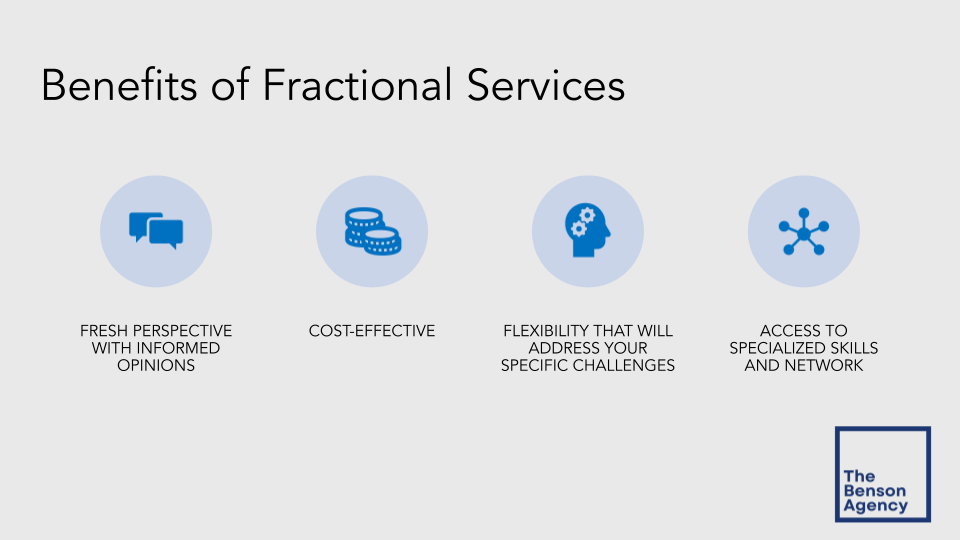
No one approach is better than the other - it truly depends on your unique needs, budget, and goals.
The key is to truly lay those out when you build your staffing plan and budget, so that you bring on the right people at the right time. A strong fractional employee may solve for workforce shortages, unexpected c-suite transitions, or meeting your needs when you are in a growth stage.
When you interview a potential fractional staff member, make sure to consider the following items:
What does their client load look like? Are they able to truly devote the time and energy to your organization that you need them to?
Do they bring additional resources? An internal staff person brings their own experience and skills. A fractional staff member may bring along others from their agency that can help provide service to you at no additional cost.
Do they have the deep level of network, experience and expertise that you require in an employee?
What is their track record with other organizations in which they have served in this capacity.
Will they truly dream about your goals, build strategies in the shower to meet those goals, and get excited about your growth when they are driving? In other words, will they be as invested in your success as you are?
They say necessity is the mother of all invention. Hiring a fractional employee may just be the idea that will solve for your necessity now and in the future.
